AdaPolicy: Action-Driven Anticipatory Robot Policies via Next-Chunk Prediction
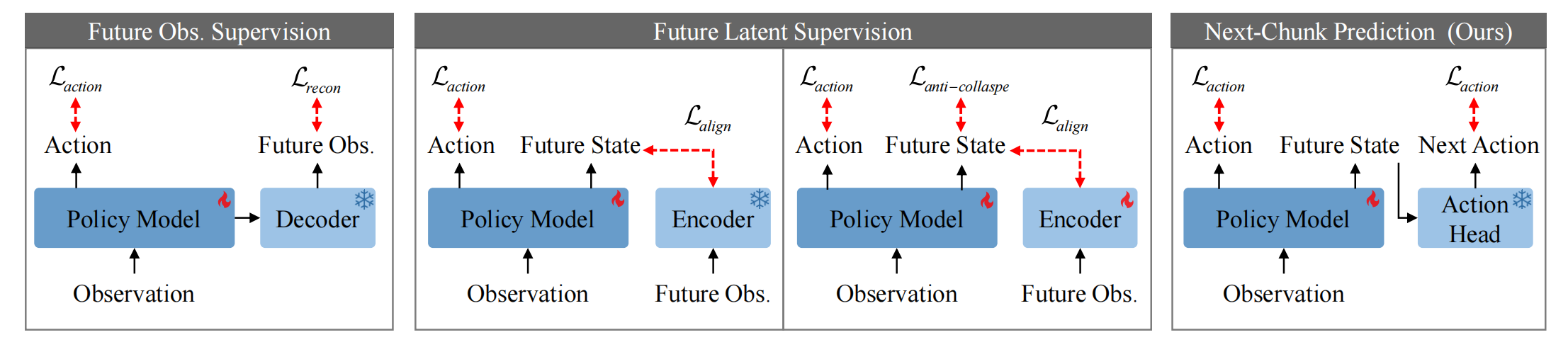
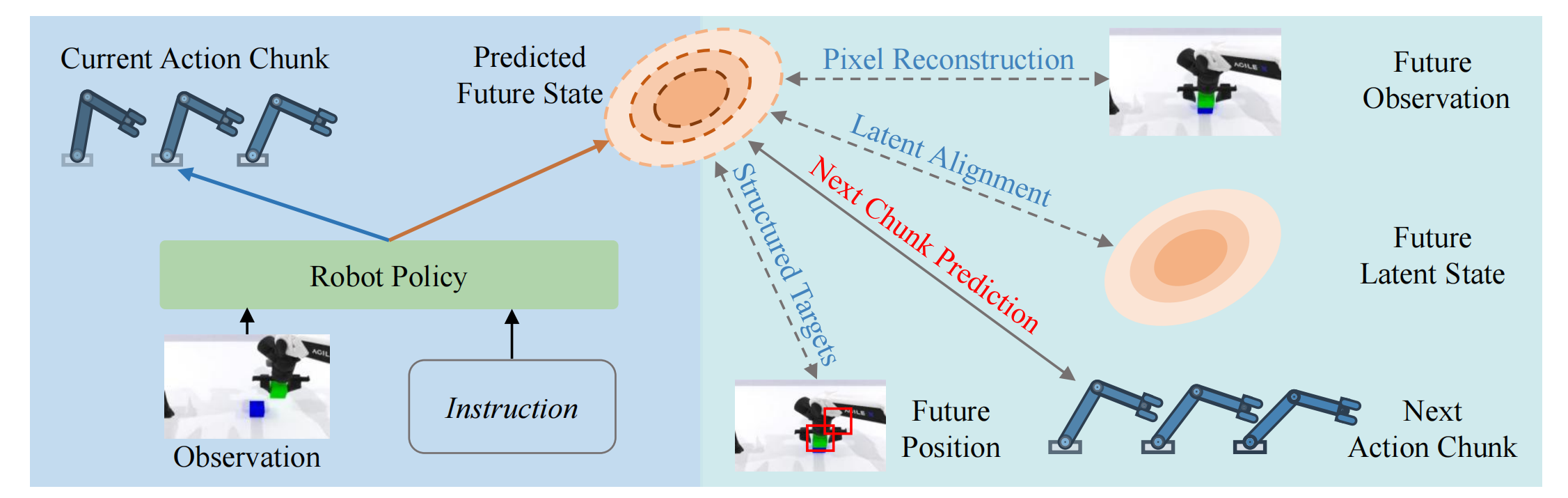
Comparison of future-supervision signals for robot policies. Existing methods supervise the predicted future state with explicit targets derived from future observations (pixel reconstruction, latent alignment, or structured geometric targets), whereas AdaPolicy uses the next action chunk as a control-aligned supervision signal, requiring no explicit future-observation targets.
Real-World Continuous Testing: 30-Minute Earphone Assembly
AdaPolicy vs. Baseline
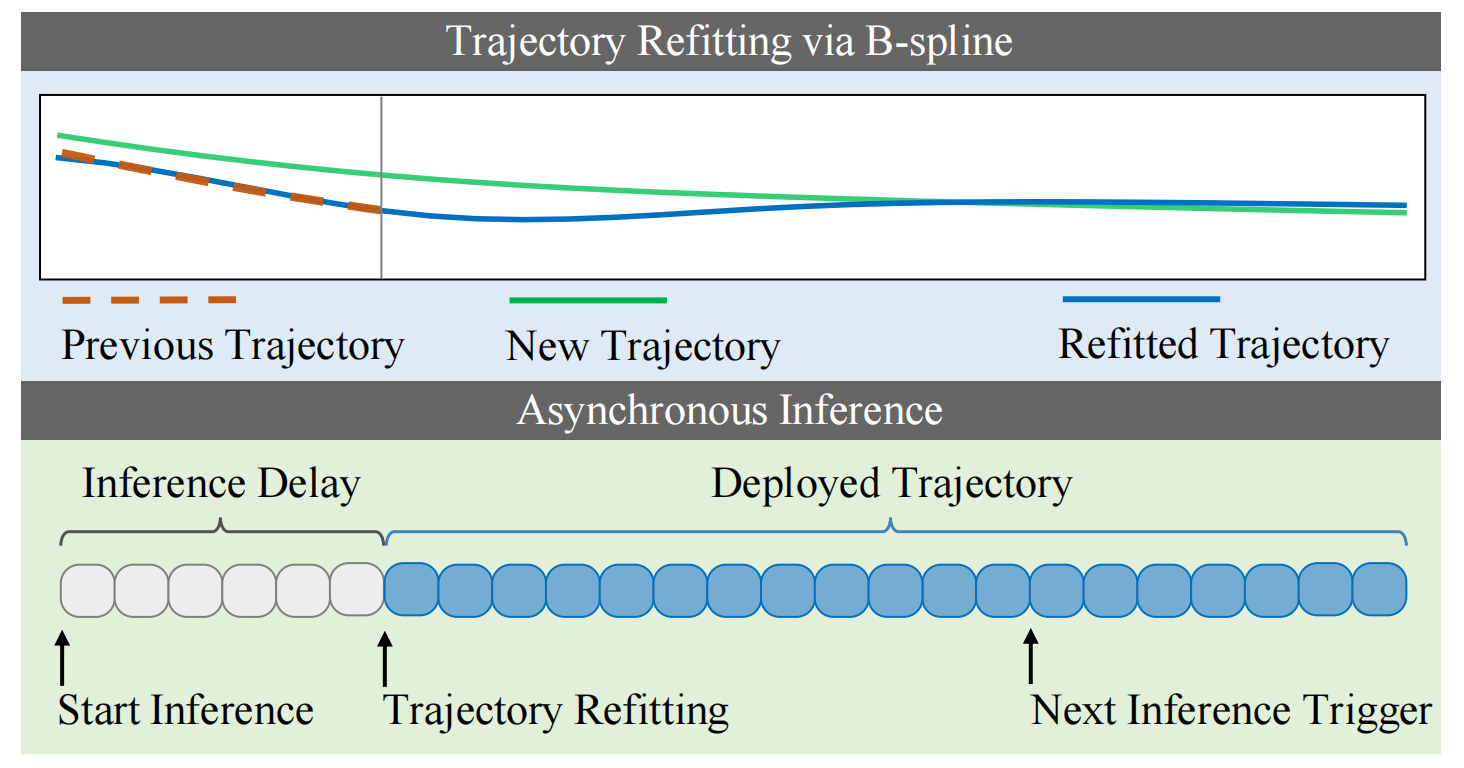
Real-World Deployment: Asynchronous Inference with B-spline Trajectory Refitting
Shoelace Threading Task
Earphone Assembly Task
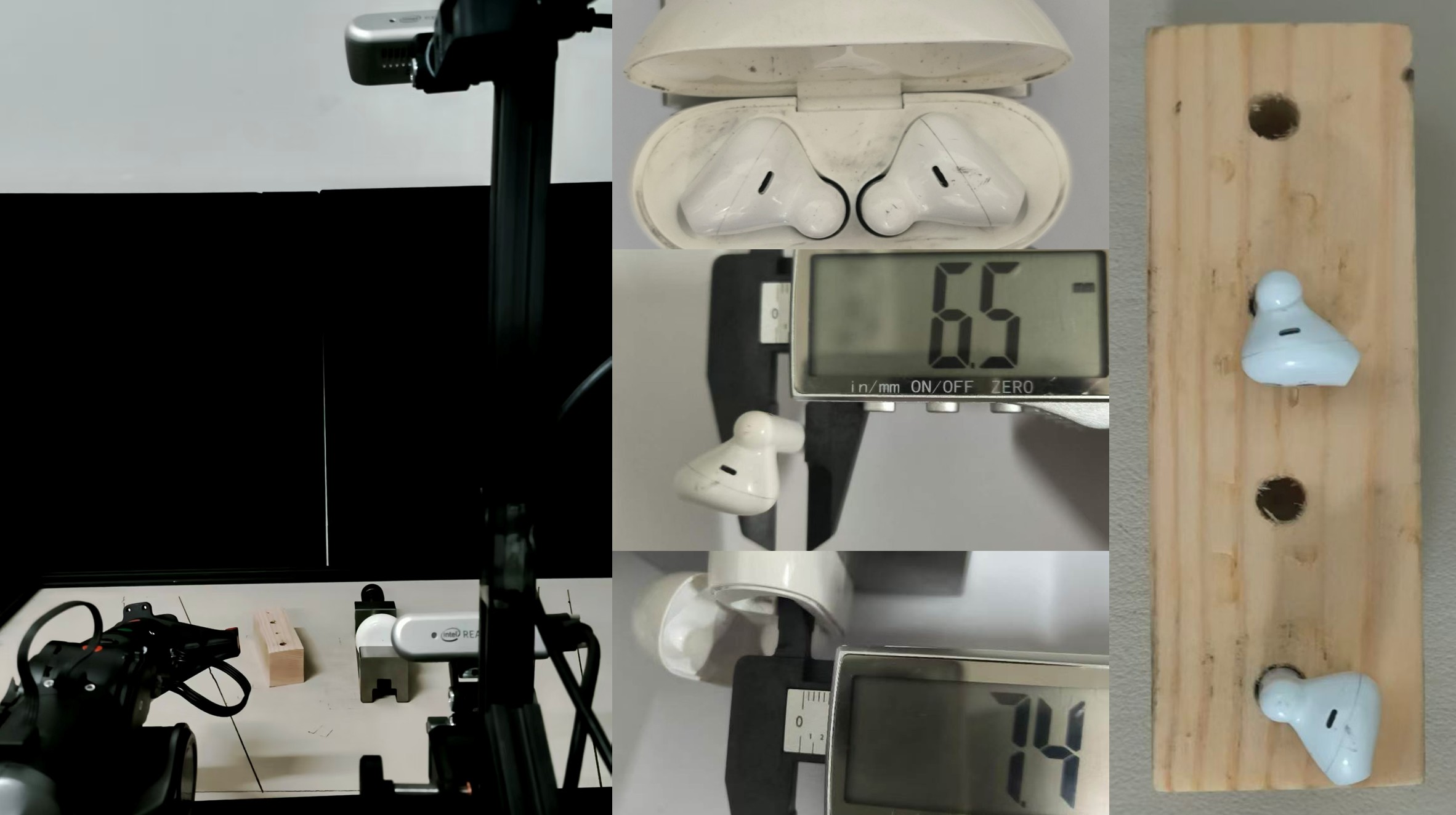
Our system utilizes a Piper robotic arm and two RealSense D435 cameras positioned in a third-person perspective.
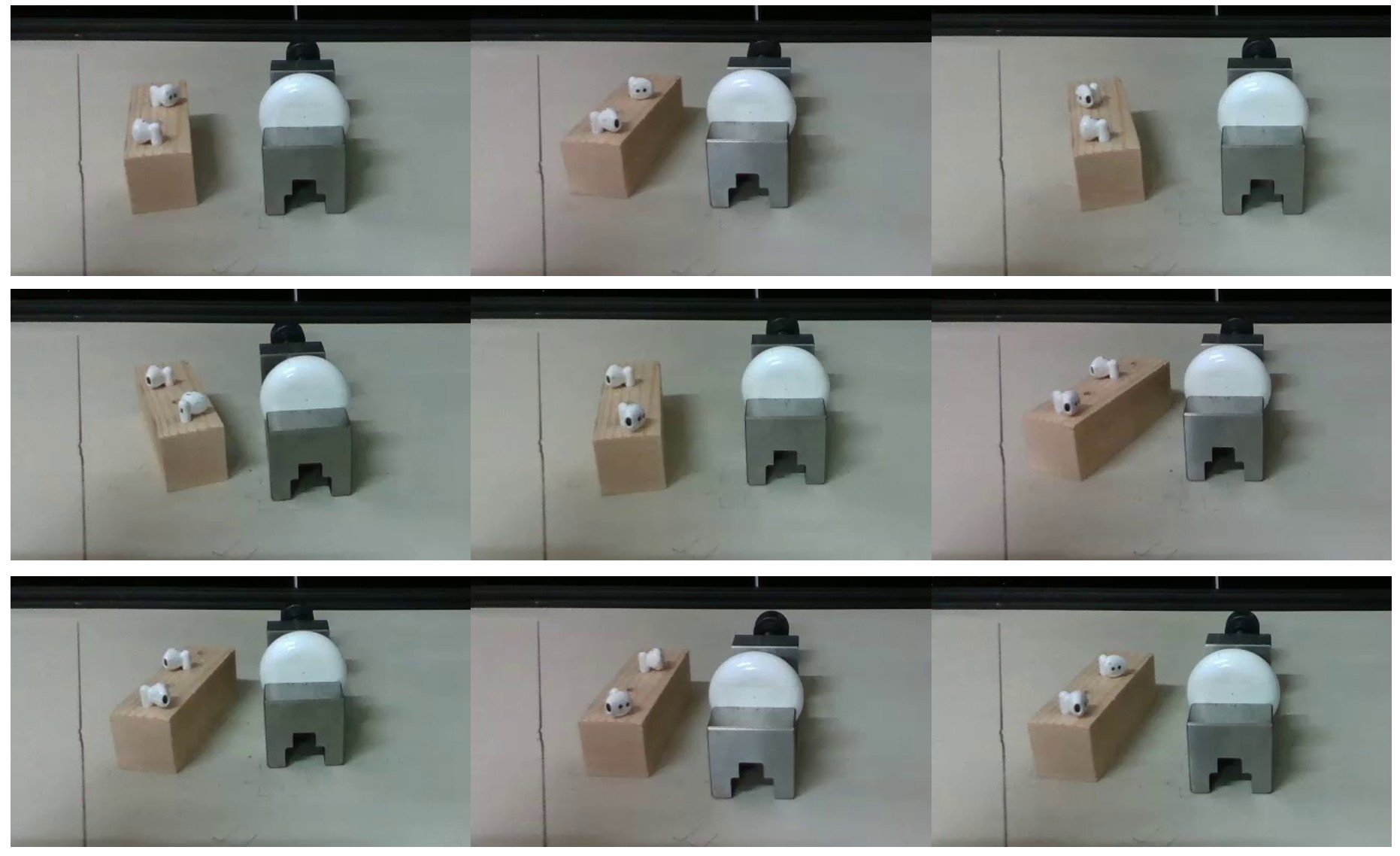
Randomization of Object Initial Poses in Real-World Experiments.
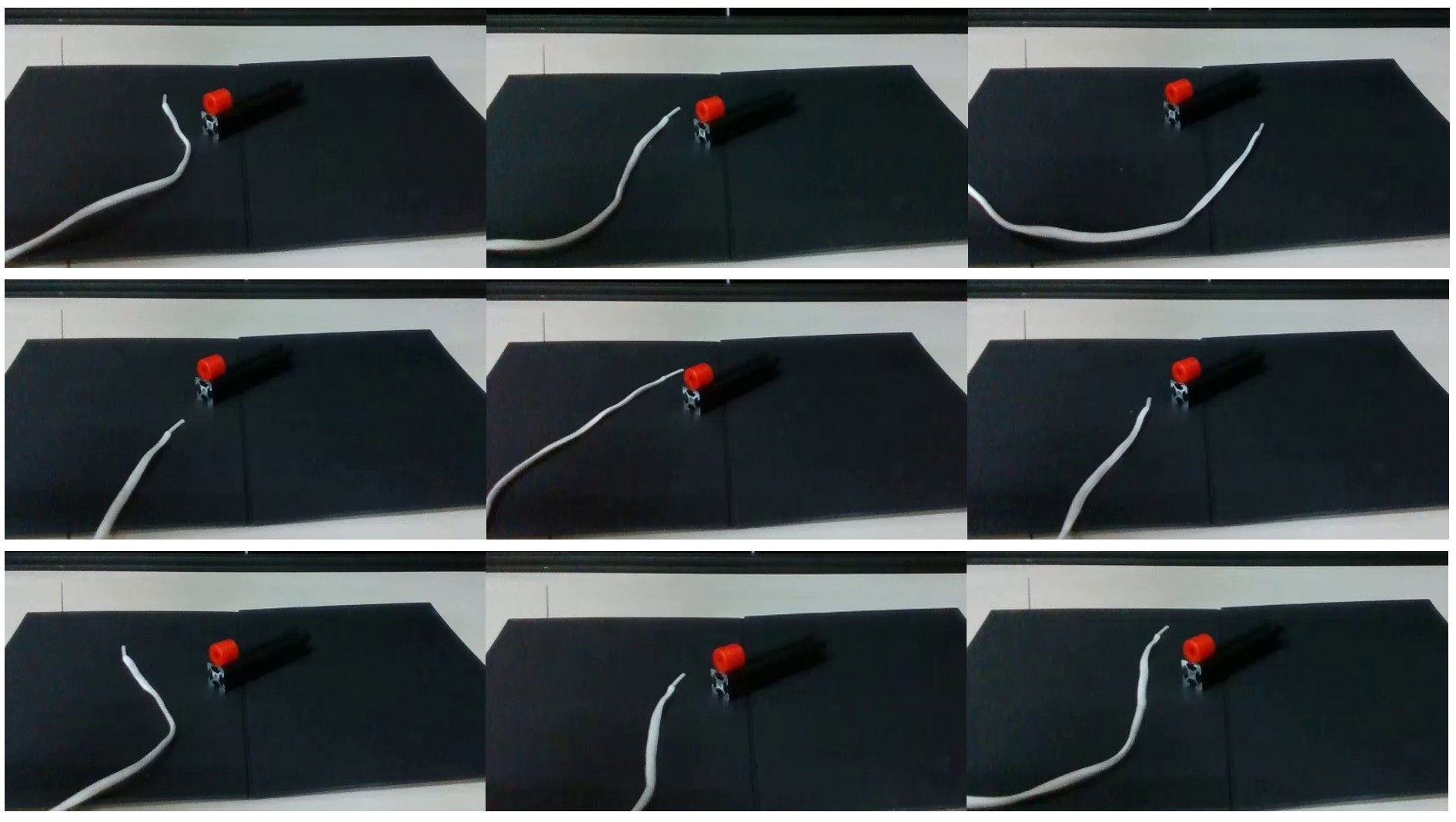
Randomization of Object Initial Poses in Real-World Experiments.
More Real-World Experiments: Block/cup stacking, button pressing, and lid opening.
Failure Case: Baseline Method on the Button Pressing Task
Robot-Camera View (Including Recovery from Suboptimal States)
Robot-Camera View (Failure Cases)
Abstract
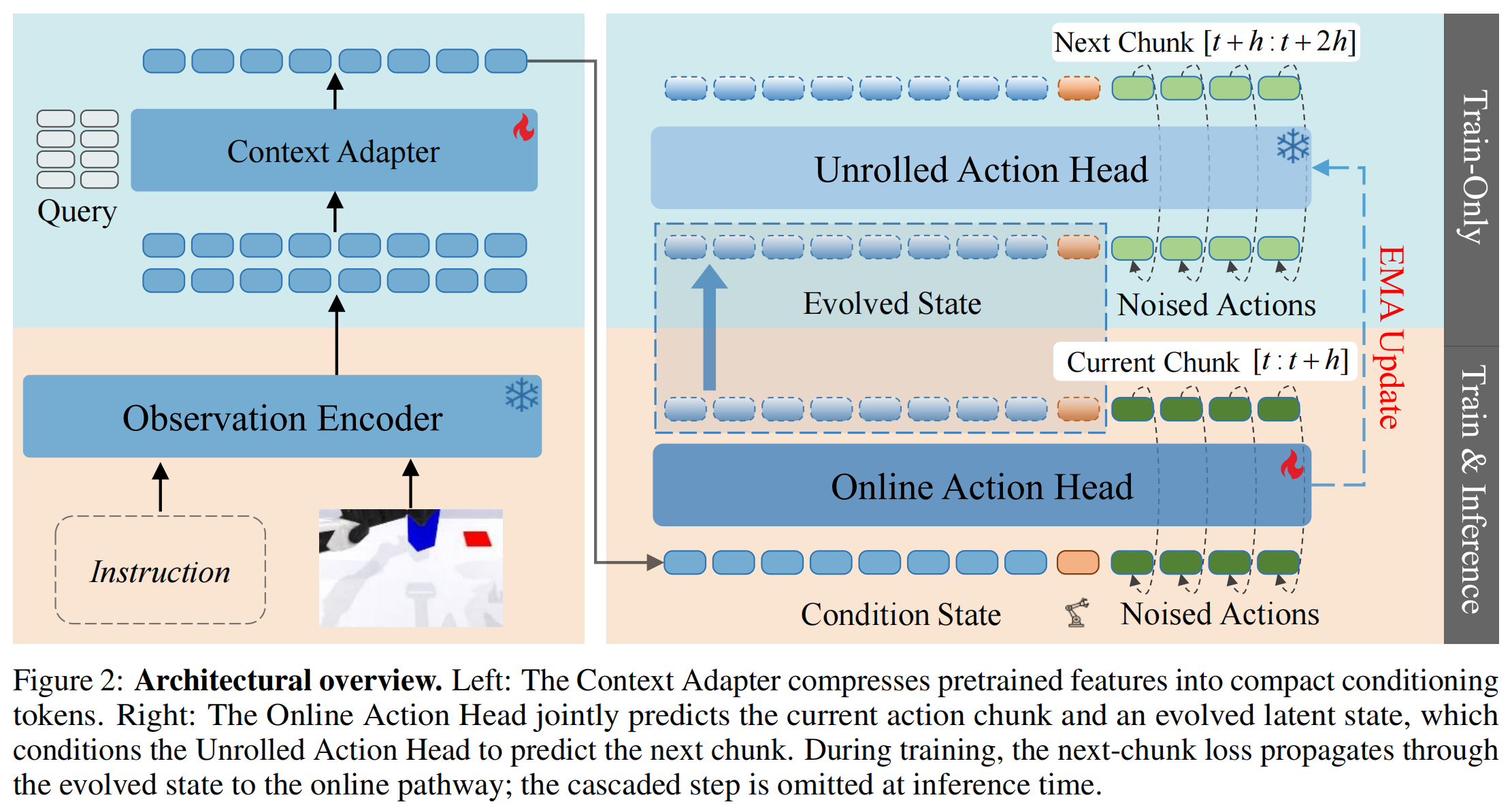
Endowing robot policies with anticipatory capabilities has proven effective in improving control performance. However, existing methods predominantly rely on explicit supervision derived from future observations, in either pixel or latent space, at the cost of additional architectural and computational complexity. Departing from explicit future supervision, we ask whether such foresight can be elicited directly from the action signal. To this end, we propose AdaPolicy, an action-driven anticipatory policy framework that shapes future-aware representations via cascaded next-chunk prediction. Specifically, an Online Action Head jointly produces the current action chunk and an evolved latent state. Building on this state, a cascaded Unrolled Action Head forecasts the next chunk, and the resulting loss flows back through the evolved state to instill implicit foresight into the online policy. Importantly, the unroll operates only during training, making AdaPolicy plug-and-play with no inference-time overhead. Experiments on MetaWorld, RoboTwin 2.0, LIBERO, and real-world deployments demonstrate consistent gains across diverse settings, including up to 14 percentage points on millimeter-precision tasks such as earphone assembly and shoelace threading. More details and visualizations are available at https://teee111.github.io/AdaPolicy/.